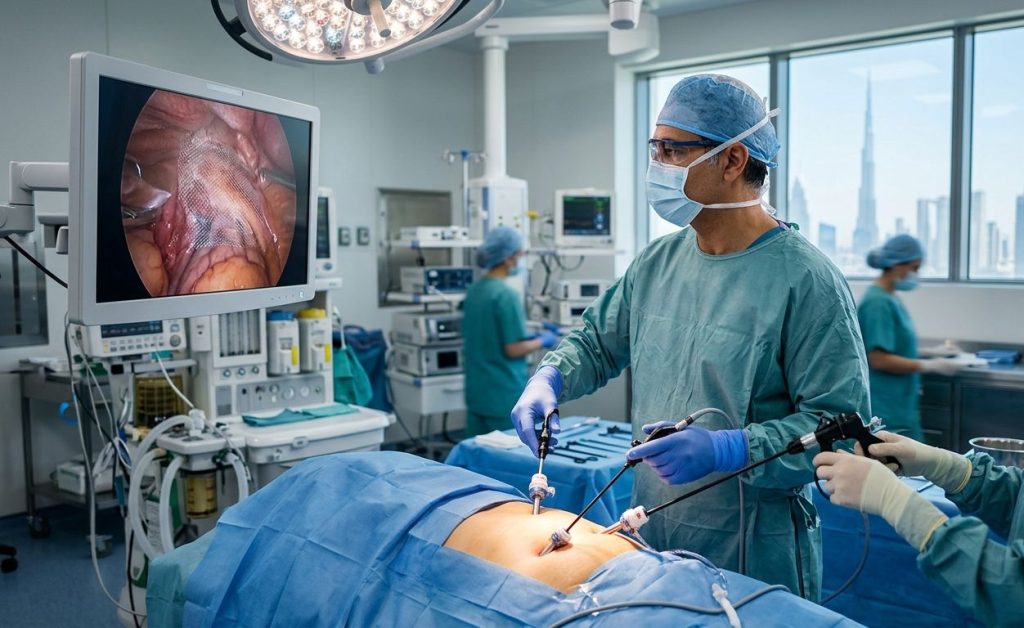


Is Laparoscopic Surgery Covered by Insurance in Dubai?
Facing a recommended surgery is stressful enough without also trying to decode what your insurance policy will and won’t pay for. If you’ve been told you need a laparoscopic procedure and your next question is “how much of this will I actually owe,” you’re asking the right question at the right time — before, not after, the operation.
Dr. Nazim Alrifai is a Consultant General Surgeon at Al Zahra Hospital Dubai with over 18 years of experience in laparoscopic and minimally invasive surgery. This guide explains how health insurance coverage for laparoscopic surgery actually works in Dubai, what determines whether your procedure is approved, and how a properly managed pre-operative pathway protects both your health and your finances.
How Health Insurance Coverage Works in Dubai
Health insurance has been mandatory for every Dubai resident since Dubai Law No. 11 of 2013, and since January 2025 this requirement has extended nationwide across all seven emirates. Every DHA-compliant policy, from the basic Essential Benefits Plan (EBP) to comprehensive private cover, is required to include a minimum annual benefit limit and to cover inpatient treatment, surgeries, diagnostics, and specialist care — but the extent of that coverage, and what you personally pay, depends entirely on your specific plan.
Basic Plans (Essential Benefits Plan)
The EBP is the minimum legally required coverage in Dubai, primarily for employees earning AED 4,000 or less per month and their non-working dependents. It provides an annual claims limit of AED 150,000 and covers medically necessary inpatient treatment, including surgery, typically with a 20% co-payment on non-emergency medical treatment, subject to per-encounter and annual caps defined by your specific policy.
Comprehensive and Enhanced Plans
Employer-provided or privately purchased comprehensive plans generally offer broader hospital networks, lower co-payments, and higher or unlimited annual claim limits. These plans typically allow more direct access to a specialist, whereas basic plans usually require a GP referral first — a process that can take one to two business days and is worth factoring into your surgical timeline.
Is Laparoscopic Surgery Specifically Covered?
Laparoscopic surgery performed for a documented medical indication — such as symptomatic gallstones, a diagnosed hernia, or another condition confirmed through clinical assessment and imaging — is generally covered under DHA-compliant insurance plans, in whole or in part, because it is classified as medically necessary rather than elective or cosmetic.
What Typically Determines Approval
- A confirmed medical diagnosis, supported by clinical assessment and relevant imaging or lab results
- Pre-authorization, which most insurers require before a non-emergency surgical admission — proceeding without it can result in a claim being reduced or denied
- In-network facility and surgeon, since out-of-network care is often covered at a lower percentage or excluded entirely, depending on your policy
- Medical necessity versus elective classification — cosmetic or purely elective procedures are typically excluded, even when performed laparoscopically
Why Choosing an Experienced Laparoscopic Surgeon Matters

Insurance approval is only one part of the equation — the surgeon performing your procedure has a direct bearing on both your clinical outcome and, in practical terms, the total cost your policy and you ultimately absorb.
Accurate diagnosis reduces disputed claims. An experienced surgeon’s pre-operative assessment produces the clear clinical documentation insurers require for pre-authorization, reducing the risk of delays or claim rejection due to incomplete justification.
Fewer complications mean fewer additional claims. Complications arising from technical error, such as bile duct injury or inadequate hernia mesh placement, often require further treatment — additional costs that may not be fully covered if linked to a preventable surgical complication.
Appropriate case management avoids unnecessary escalation. A seasoned surgeon can distinguish between a straightforward case suited to day-surgery and a complex one requiring extended admission, ensuring your treatment plan — and your claim — accurately reflects your actual clinical need.
Dr. Alrifai’s background across Al Zahra Hospital Dubai, Rashid Hospital, and international consultant roles reflects the depth of clinical judgment required to manage both the surgical and administrative sides of your care with precision.
What to Expect: The Pre-Operative and Insurance Pathway
Pre-Operative Clinical Assessment
Every patient undergoes a thorough evaluation, including symptom history, relevant imaging, and a review of overall health status. This step confirms the medical necessity of the recommended procedure and produces the documentation your insurer will require.
Insurance Verification and Pre-Authorization
Before your surgery is scheduled, your policy’s coverage, network status, and any co-payment obligations are verified, and the required pre-authorization is submitted to your insurer with the supporting clinical documentation.
Personalized Care Planning
Your surgical and recovery plan is built around your specific diagnosis, health status, and insurance parameters — including whether your case is suited to same-day discharge or requires an overnight stay, which directly affects your claim.
Post-Operative Prognosis and Follow-Up
Most patients undergoing routine laparoscopic procedures have a favourable post-operative prognosis, with structured follow-up visits typically included within your surgical package or covered under your policy’s outpatient benefit.
Common Reasons Claims Are Delayed or Denied
- Proceeding with a non-emergency admission without prior pre-authorization
- Treatment received at an out-of-network facility without confirming coverage first
- Insufficient documentation linking the procedure to a medically necessary diagnosis
- Procedures classified as elective or cosmetic under the policy’s exclusions
- Treatment for a pre-existing condition within a policy’s initial waiting period, typically six months from enrollment
Clinical Considerations and Guidelines
Insurance approval should never be the deciding factor in surgical planning — clinical necessity is. A responsible surgical pathway follows established clinical guidelines for diagnosis, appropriate case selection, and safe intra-operative technique, with the insurance and documentation process running in support of that clinical decision, not ahead of it. This is also why working with a surgical team experienced in navigating Dubai’s insurance framework matters: it prevents administrative delays from interfering with timely, medically appropriate care.
Frequently Asked Questions
Does health insurance in Dubai cover laparoscopic gallbladder or hernia surgery?
Yes, in most cases. Laparoscopic surgery performed for a confirmed medical condition, such as symptomatic gallstones or a diagnosed hernia, is generally covered under DHA-compliant insurance plans, subject to your specific policy’s co-payment structure, annual limit, and pre-authorization requirements.
Do I need pre-authorization before laparoscopic surgery in Dubai?
Most insurers require pre-authorization for non-emergency surgical admissions. Proceeding without it can result in your claim being reduced or denied, so confirming approval before your procedure is scheduled is an essential step in the process.
What if my surgeon or hospital is outside my insurance network?
Out-of-network care is often covered at a lower percentage, or may not be covered at all, depending on your specific policy. Confirming that your surgeon and hospital are within your plan’s network before proceeding helps avoid unexpected out-of-pocket costs.
Will my insurance cover a laparoscopic procedure if it’s linked to a pre-existing condition?
Coverage for pre-existing conditions is typically excluded during an initial waiting period, commonly six months from when you first joined your current insurance scheme. After this period, medically necessary treatment is generally covered within your policy’s standard limits.
This information is for educational purposes and does not replace professional medical advice. Please consult with Dr. Nazim Alrifai for your specific clinical needs.