

Expert Laparoscopic Hernia Repair Surgeon in Dubai
A bulge that wasn’t there before. A pull of discomfort when you lift, cough, or stand for too long. Left untreated, a hernia doesn’t resolve on its own — and the anxiety of not knowing when it will worsen is often harder to carry than the physical symptom itself.
Dr. Nazim Alrifai is a fellowship-trained advanced laparoscopic and minimally invasive surgeon based at Al Zahra Hospital Dubai, with extensive experience across the full spectrum of hernia repairs — from straightforward inguinal cases to complex incisional and recurrent presentations. This article explains what laparoscopic hernia repair involves, the anatomical precision it demands, and what a properly guided surgical pathway looks like from first consultation to full recovery.
Understanding Hernias and When Surgery Is Indicated
A hernia occurs when internal tissue or organ pushes through a weakened area of the abdominal wall, most commonly at the groin (inguinal), navel (umbilical), or the site of a previous surgical incision. Hernias do not resolve spontaneously and typically progress in size over time, with the associated risk of incarceration or strangulation — a surgical emergency in which blood supply to the herniated tissue is compromised.
When Repair Becomes Necessary
- A visible or palpable bulge that increases with straining, coughing, or standing
- Persistent discomfort or a dragging sensation at the hernia site
- A hernia that has enlarged since first noticed
- Any sudden, severe pain, redness, or inability to reduce the bulge — a signal for urgent evaluation
Why Choosing an Experienced Laparoscopic Surgeon Matters
Hernia anatomy is rarely as simple as textbook diagrams suggest. The inguinal region in particular contains a dense network of nerves, vessels, and the spermatic cord in men — structures that vary subtly from patient to patient. This anatomical variability is precisely why surgeon experience has a direct, measurable bearing on outcome.
Anatomical fluency reduces risk. An experienced laparoscopic surgeon recognizes anatomical variants in real time — critical for avoiding nerve entrapment, vascular injury, or inadequate mesh coverage, all of which are associated with less experienced hands.
Precision lowers recurrence. Recurrence after hernia repair is most often linked to inadequate mesh overlap or imprecise fixation — errors that decline sharply with surgical volume and specialized laparoscopic training.
Complication mitigation. Dense adhesions from prior surgery, bilateral presentations, or unexpectedly large defects require the surgeon to adapt the operative plan intraoperatively rather than follow a rigid protocol — a skill built through case volume, not theory alone.
Dr. Al Rifai brings technical precision, evidence-based mesh selection, and a consistent commitment to patient outcomes to every case — the qualities that distinguish a genuinely expert laparoscopic hernia repair surgeon in Dubai from a general practitioner performing occasional repairs.
Clinical Precision: Pre-Operative Mapping and Personalized Pathways
Precision in laparoscopic hernia repair begins long before the operating theatre.
Pre-Operative Assessment
Every patient undergoes a detailed clinical evaluation, often supported by targeted imaging, to confirm hernia type, size, and any anatomical complexity — particularly in recurrent or incisional cases where prior surgical planes must be accounted for. This assessment is what allows the surgical team to select the correct technique and mesh strategy in advance, rather than deciding reactively during the procedure.
Personalized Care Pathway
The surgical approach is tailored to the individual: a straightforward unilateral inguinal hernia in an otherwise healthy patient is managed differently from a complex, recurrent, or bilateral presentation. This individualized pathway extends through anaesthesia planning, mesh selection, and the post-operative recovery protocol.
Intra-Operative Technique
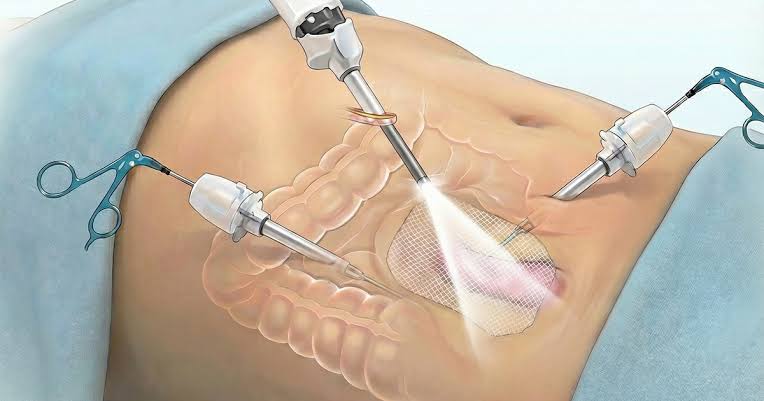
Dr. Al Rifai employs the TEP (Totally Extraperitoneal) or TAPP (Transabdominal Preperitoneal) laparoscopic approach for inguinal hernias, selected according to individual anatomy and case complexity, with a lightweight, anatomically fitted mesh placed to reinforce the abdominal wall with broad margin coverage. For umbilical and incisional defects, an intraperitoneal onlay mesh (IPOM) technique is used through small ports to reduce recurrence risk compared with primary suture repair alone. For large incisional, recurrent, or anatomically complex cases, a robotic-assisted platform offers enhanced 3D visualization and wristed instrument dexterity for precise fascial closure alongside mesh reinforcement.
What to Expect: The Surgical Journey
Before Surgery
You arrive at the accredited Dubai surgical facility at your scheduled time, following pre-operative anaesthesia consultation and any required investigations.
During Surgery
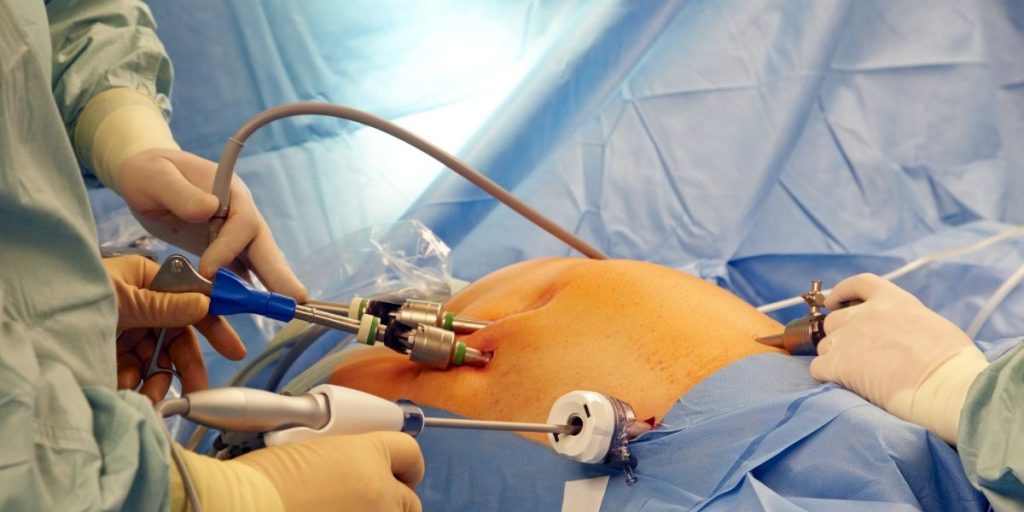
Laparoscopic or robotic hernia repair is performed under general anaesthesia, typically within 45 to 90 minutes depending on complexity. Repair is carried out through three small incisions of 5–10mm. For bilateral inguinal hernias, both sides are repaired through the same access points, without additional incisions — a distinct advantage of the laparoscopic approach over open surgery.
After Surgery
Most patients are ambulatory within two to four hours and are discharged the same day or after a single overnight stay. Dr. Al Rifai personally briefs your family or companion immediately following the procedure. You leave with a written recovery plan, prescribed analgesia, activity guidance, and a direct contact number for the surgical team.
Post-Operative Prognosis
Post-operative pain following laparoscopic repair is generally minimal compared with open techniques. A scheduled follow-up at one to two weeks confirms wound healing and recovery progress, with further appointments arranged as clinically appropriate. Recurrence rates for laparoscopic inguinal repair, in experienced hands, are comparable to open surgery, with a meaningfully better pain profile and faster return to activity.
Benefits of the Laparoscopic and Robotic Approach
- Three small incisions (5–10mm) instead of a single 10–20cm open incision
- Incision sites become virtually invisible within months
- Minimal post-operative pain relative to open repair
- Bilateral hernias repaired through the same access points
- Faster return to normal activity and work
- Recurrence rates comparable to open surgery when performed by an experienced surgeon
Clinical Considerations and Safety Standards
Responsible hernia repair follows internationally recognized surgical guidelines, including evidence-based mesh selection appropriate to defect size and location, meticulous fascial closure technique, and clearly defined criteria for converting to an open approach when intraoperative findings warrant it. This structured, guideline-driven process — rather than technique in isolation — is what protects long-term outcomes and minimizes recurrence risk.
Understanding the Cost of Laparoscopic Hernia Repair in Dubai
Laparoscopic inguinal hernia repair typically ranges from AED 12,000 to AED 25,000 for uncomplicated cases, inclusive of surgeon fees, anaesthesia, facility charges, and standard post-operative follow-up. Complex, bilateral, or robotic-assisted repairs are priced individually after clinical assessment. The majority of medically indicated hernia repairs are covered by Dubai and UAE health insurance plans, including DHA-network, Thiqa, and major employer-sponsored schemes, with pre-authorization managed on your behalf.
Frequently Asked Questions
What is the best surgical technique for inguinal hernia repair?
For most inguinal hernias, laparoscopic repair using the TEP or TAPP technique is considered a leading approach, offering smaller incisions, less post-operative pain, and recurrence rates comparable to open surgery when performed by an experienced surgeon. The most suitable technique depends on individual anatomy, hernia type, and whether the case is bilateral or recurrent.
How long does recovery take after laparoscopic hernia surgery?
Most patients are ambulatory within two to four hours of surgery and are discharged the same day or after one overnight stay. Post-operative pain is generally minimal, and many patients return to light activity within days, with a follow-up visit scheduled at one to two weeks to confirm healing.
Can both sides be repaired in one surgery for a bilateral hernia?
Yes. With the laparoscopic approach, both sides of a bilateral inguinal hernia are repaired through the same three small incisions, without requiring any additional cuts — a key advantage over open surgical technique.
How much does laparoscopic hernia repair cost in Dubai?
Laparoscopic inguinal hernia repair in Dubai typically costs between AED 12,000 and AED 25,000 for uncomplicated cases, covering surgeon fees, anaesthesia, facility charges, and standard follow-up. Complex or bilateral cases are quoted individually following clinical assessment, and most medically indicated repairs are covered by UAE health insurance.
Take the Next Step With Confidence
Understanding your hernia and the right repair approach shouldn’t require guesswork. The most reliable way to know your surgical plan — and your true cost — is a proper pre-operative assessment tailored to your anatomy and health history.
Schedule a consultation with Dr. Nazim Alrifai for a clear, personalized care pathway, so you can move forward with confidence, not uncertainty.
📍 Al Zahra Hospital Dubai, Sheikh Zayed Road 📞+971 55 335 1052
Medical Disclaimer: This information is for educational purposes and does not replace professional medical advice. Please consult with Dr. Nazim Alrifai for your specific clinical needs.